
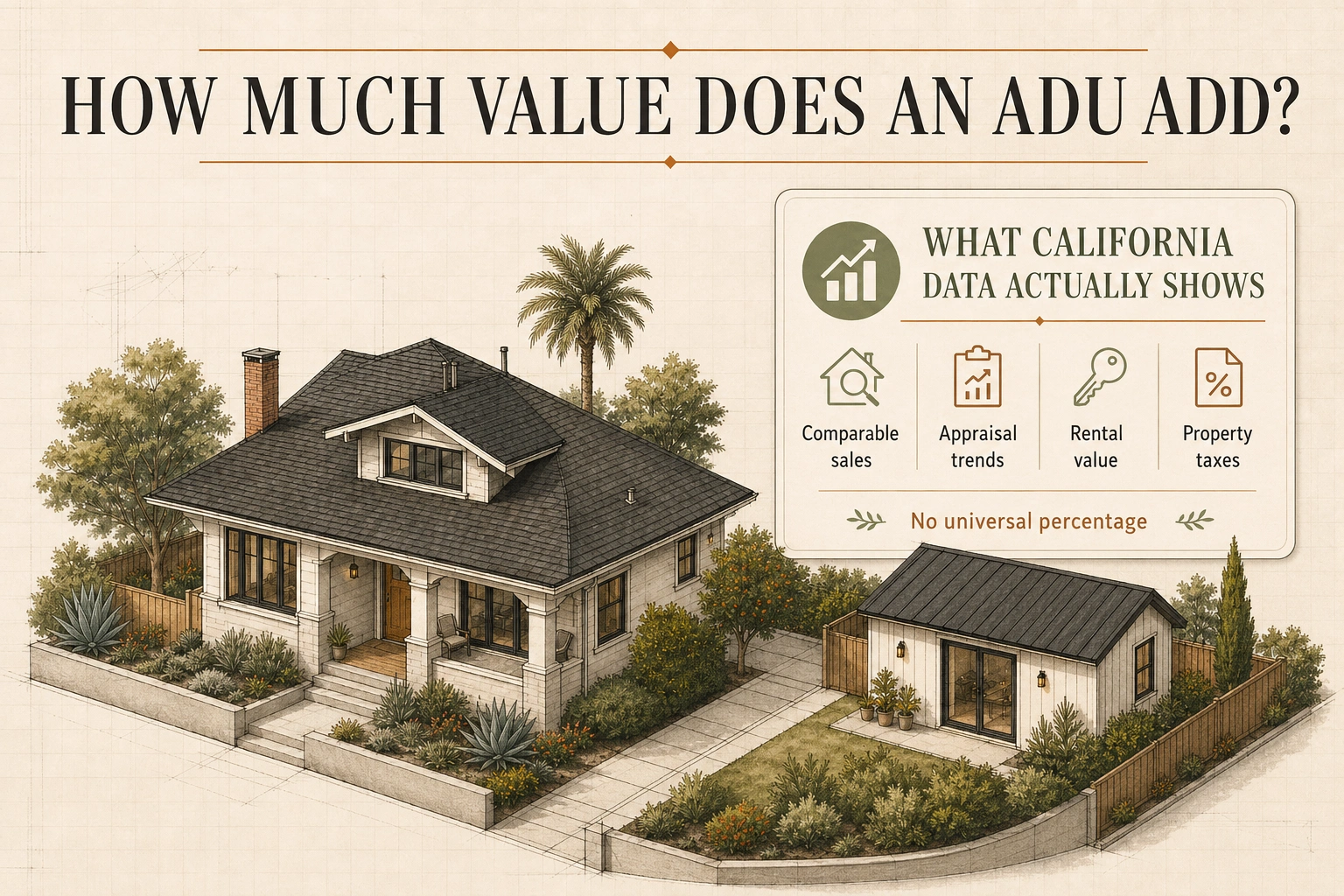
Short answer: there is no reliable statewide percentage that predicts what an ADU will add to your California property. Use recent comparable sales and a documented local appraisal. The historical Los Angeles research discussed below is context—not a current valuation or a return guarantee.
That distinction matters. A permitted, usable ADU will often add value, but the amount depends on the local buyer pool, comparable sales, rental demand, size, privacy, condition, parking, and whether the project fits the property. It can also cost more to build than it adds at resale.
The evidence in one minute
- Historical Los Angeles study: roughly 7%–9% in Los Angeles.
- Statewide appraisal trend: California properties reported with ADUs had higher median appraised values and faster 2013–2023 growth, but the data does not isolate the ADU as the cause.
- What appraisers actually do: analyze comparable sales and market reaction; they do not simply add the primary home’s full price per square foot.
- What homeowners should assume: value is local and contributory. Get an appraisal or broker analysis using nearby permitted-ADU sales before treating resale value as project revenue.
In this guide
What does the historical Los Angeles study tell us?
The clearest published estimate comes from a 2024 peer-reviewed study in Real Estate Economics. Researchers Jan Brueckner and Sarah Thomaz analyzed Los Angeles assessor data from 2013 through 2019, including almost 100,000 recently sold properties. Their preferred results put the effect of an ADU at approximately 7% to 8% for assessed value and close to 9% for recently sold properties.
The authors describe the recently sold sample as the more useful measure of the sales-price effect because California assessed value is reset to the transaction price after a sale. You can read the published Los Angeles ADU value study.
Use this as research context, not a parcel calculator. The historical Los Angeles estimate cannot determine the value of your proposed unit. Request local comparable sales and a documented as-completed opinion instead of multiplying your home value by the study percentage.
Even the Los Angeles study cannot tell you what a particular garage conversion, 800-square-foot detached ADU, or unpermitted unit will add in your neighborhood today.
What the statewide FHFA data shows—and what it does not
A 2025 analysis from the Federal Housing Finance Agency offers a second useful view. It examined purchase-loan appraisals submitted to Fannie Mae and Freddie Mac.
- In 2013, the median appraised value was $550,000 for California properties reported with ADUs and $405,000 for those without.
- By 2023, those medians were $1.064 million and $715,000.
- Annualized median-value growth from 2013 to 2023 was 9.34% for the ADU group and 7.65% for the non-ADU group.
It is tempting to subtract $715,000 from $1.064 million and say the ADU “added $349,000.” That would be wrong. These are two different groups of properties, not otherwise identical homes measured before and after an ADU was built. Homes with ADUs may be in more expensive locations, sit on different lots, have different quality, or attract different buyers. FHFA itself says the higher growth requires more study and warns that the ADU field may contain appraisal data-entry errors.
The correct takeaway is narrower: California homes appraised with ADUs have been a higher-value and faster-growing segment in this federal dataset. The data supports market acceptance, but not a fixed dollar premium for your parcel.
Why the common 30% rule is unreliable
Several pages ranking for this topic say an ADU generally adds 30% to a home’s value. Others multiply monthly rent by 100 or apply the primary home’s full price per square foot to the ADU.
Those shortcuts can produce unrealistic answers:
- A $1.2 million home would supposedly gain $360,000 under a 30% rule regardless of whether the ADU is a 350-square-foot garage conversion or a new 1,000-square-foot detached home.
- A neighborhood price of $800 per square foot does not mean an 800-square-foot ADU automatically adds $640,000. ADU area is usually analyzed separately from the primary dwelling.
- Monthly rent is relevant to some buyers and loan programs, but a simple 100-times-rent multiplier ignores expenses, vacancy, capitalization rates, financing, condition, and comparable sales.
The peer-reviewed Los Angeles result is far below 30%. More importantly, current appraisal guidance requires market evidence rather than a mechanical rule.
How appraisers value a California property with an ADU
Under current Fannie Mae appraisal guidance, an ADU must be described and its effect on value and marketability analyzed. In most cases, the ADU’s living area is reported separately from the primary dwelling and adjusted on a separate line in the sales-comparison grid.
Freddie Mac similarly directs appraisers to use a comparable sale with an ADU when one is available. If recent local ADU sales are scarce, an appraiser may consider older sales, a competing neighborhood, additional listings, or supported comparisons with homes that do not have ADUs.
In practice, the appraiser may consider three approaches:
1. Sales comparison
This is usually the most important resale evidence. The appraiser compares your property with recent sales and supports an adjustment for the ADU based on how buyers reacted to similar units. The quality of the result depends on the availability of genuinely comparable permitted-ADU sales.
2. Income support
Market rent can help demonstrate demand and may be relevant when ADU rental income is permitted and typical. But owner-occupied single-family property is not automatically valued like a small apartment building. Gross rent is not the same as net income, and income does not replace the need to understand local buyer behavior.
3. Cost support
Construction cost can help describe the improvement, especially when sales evidence is thin. It does not mean a $350,000 build adds $350,000 to market value. Buyers may discount overbuilding, awkward access, lost yard or garage space, deferred maintenance, and finishes that do not fit the neighborhood.
What makes one ADU add more value than another?
Permits and legal use
A completed, permitted ADU with documented final approval gives buyers, lenders, insurers, and appraisers a clearer asset to evaluate. An unpermitted conversion is not automatically worthless, but it can reduce the buyer pool, create financing or insurance questions, and require a more complicated marketability analysis. Start with our California ADU permit process guide.
Privacy and independent function
Separate access, usable outdoor space, sound control, parking where buyers expect it, and sensible window placement can improve the unit’s appeal. A detached ADU often offers more privacy, but that does not guarantee it will deliver the best return on construction cost.
Size, bedroom count, and layout
Buyers may pay more for a functional one- or two-bedroom plan than for a larger but awkward space. A legal kitchen, bathroom, sleeping area, storage, natural light, and efficient circulation matter more than headline square footage alone. Compare the main ADU types before choosing a project.
Rental demand
A permitted ADU in a market with strong long-term rents may appeal to buyers who want income, multigenerational housing, caregiver space, or a future downsizing option. Verify local rent rules and use realistic long-term rent, vacancy, maintenance, insurance, utilities, and management assumptions.
What the project takes away
A garage conversion can remove parking and storage. A detached unit can consume yard space or reduce privacy in the main home. Utility work may leave visible compromises. The appraiser and buyer consider the net effect on the entire property, not just the added unit.
Does value added equal return on investment?
No. Property value, rental return, and family utility are different benefits.
Fictional arithmetic example, not an observed project: suppose a project costs $300,000 and adds $90,000 to immediate resale value. Its immediate value recovery is 30%, but that does not make the remaining $210,000 a “loss” if the owner receives years of rent, housing for relatives, avoided care costs, or flexible living space. Conversely, a project can add substantial value and still be a weak investment if construction overruns, financing costs, taxes, maintenance, and vacancy consume the return.
For a realistic budget, review our California ADU cost guide and the detailed garage conversion ADU cost breakdown.
How an ADU affects California property taxes
California generally treats a completed ADU as assessable new construction. The State Board of Equalization explains that the assessor establishes a new base-year value for the increment of market value added by the construction. The existing portion of the property is not reappraised simply because the ADU was built.
The added assessment is not necessarily the construction cost. Completion can also produce a supplemental assessment covering the period after the new-construction event. Ask your county assessor for a project-specific estimate; do not use the 7%–9% research range to predict a tax bill.
A better way to estimate your ADU’s likely value
- Define the finished project. Size, bedroom and bathroom count, detached or converted, parking impact, utility setup, permits, and expected completion condition.
- Find recent nearby sales with permitted ADUs. Start in the same neighborhood and school area, then expand carefully if the sample is too small.
- Compare the whole property. Lot, main-house size and condition, ADU quality, privacy, parking, and location all matter.
- Estimate stabilized long-term rent. Use permitted rental use and realistic operating costs, not short-term-rental revenue unless it is lawful and typical.
- Get a professional opinion before committing. Ask a certified residential appraiser or experienced local broker for an as-completed analysis. For financing, confirm the lender’s appraisal and rental-income rules.
- Run value, rent, and personal use separately. Do not force every benefit into a resale percentage.
Questions to ask an appraiser, broker, or lender
- Which nearby sales include a legal, permitted ADU that is genuinely comparable to this project?
- How will differences in ADU size, privacy, condition, parking and utility setup be adjusted?
- Is the opinion based on current value, as-completed value, or an assumed completion date?
- Will long-term ADU rent be considered, and if so, what rent evidence and vacancy allowance will be used?
- What happens to the financing plan if the as-completed appraisal is below the construction budget?
- Which permits, plans, inspections or certificates should be available to support legal use?
Ask for the assumptions in writing. A useful opinion explains the comparable properties and adjustments rather than applying a statewide percentage to the existing home value.
Frequently asked questions
How much does an ADU add to property value in California?
There is no reliable statewide fixed percentage. Local comparable sales, permitted use, design, condition and buyer demand determine the contributory value of a specific ADU. Historical Los Angeles findings below do not predict your parcel’s value.
Does a detached ADU add more value than a garage conversion?
Not necessarily. A detached ADU may offer more privacy, while a conversion may preserve yard space. Compare current local sales and the complete cost of each option; configuration alone does not establish resale value or return.
Does an unpermitted ADU add value?
It may have some market utility, but the value can be limited or uncertain. Appraisers must address permit and zoning issues, and lenders or insurers may impose additional requirements. A permitted unit with final approval is easier to support with market evidence.
Will an ADU increase my property taxes?
Usually, yes. The newly constructed portion is generally assessed at the market-value increment it adds. The pre-existing home and land do not receive a full reassessment solely because an ADU was completed.
Can I use rental income to calculate ADU value?
Rental income is useful supporting evidence, especially where ADU rentals are common, but a simple rent multiplier is not an appraisal. Use local long-term rent, deduct realistic expenses, and pair the income analysis with comparable sales.
The bottom line
A well-designed, permitted ADU will often increase a California property’s value. The best published sales evidence points to a result around 7%–9% in Los Angeles, while federal appraisal data confirms that ADU properties occupy a higher-value segment of California’s market. Neither source supports a universal 30% increase or a guaranteed dollar-for-dollar construction return.
Do not multiply your home value by the research percentage to set a budget. Treat the research as historical context only. Before building, compare nearby permitted-ADU sales, obtain an as-completed value opinion, estimate rent conservatively, and evaluate the project’s family and lifestyle value separately. Then use our ADU planning roadmap to move from feasibility to permits and construction.
Editorial note: This article summarizes research and general appraisal and tax guidance. It is not a property appraisal, tax advice, legal advice, or a prediction of a specific sale price.
For the borrowing implications of an as-completed appraisal, see our California ADU financing guide.
2 thoughts on “How Much Does an ADU Increase Property Value in California?”