
Last reviewed: September 5, 2026. This guide uses current California Department of Housing and Community Development guidance, current State ADU Law and official local permitting examples. Local submittal requirements still vary by city, county and property.
Quick answer: California ADU permit timeline
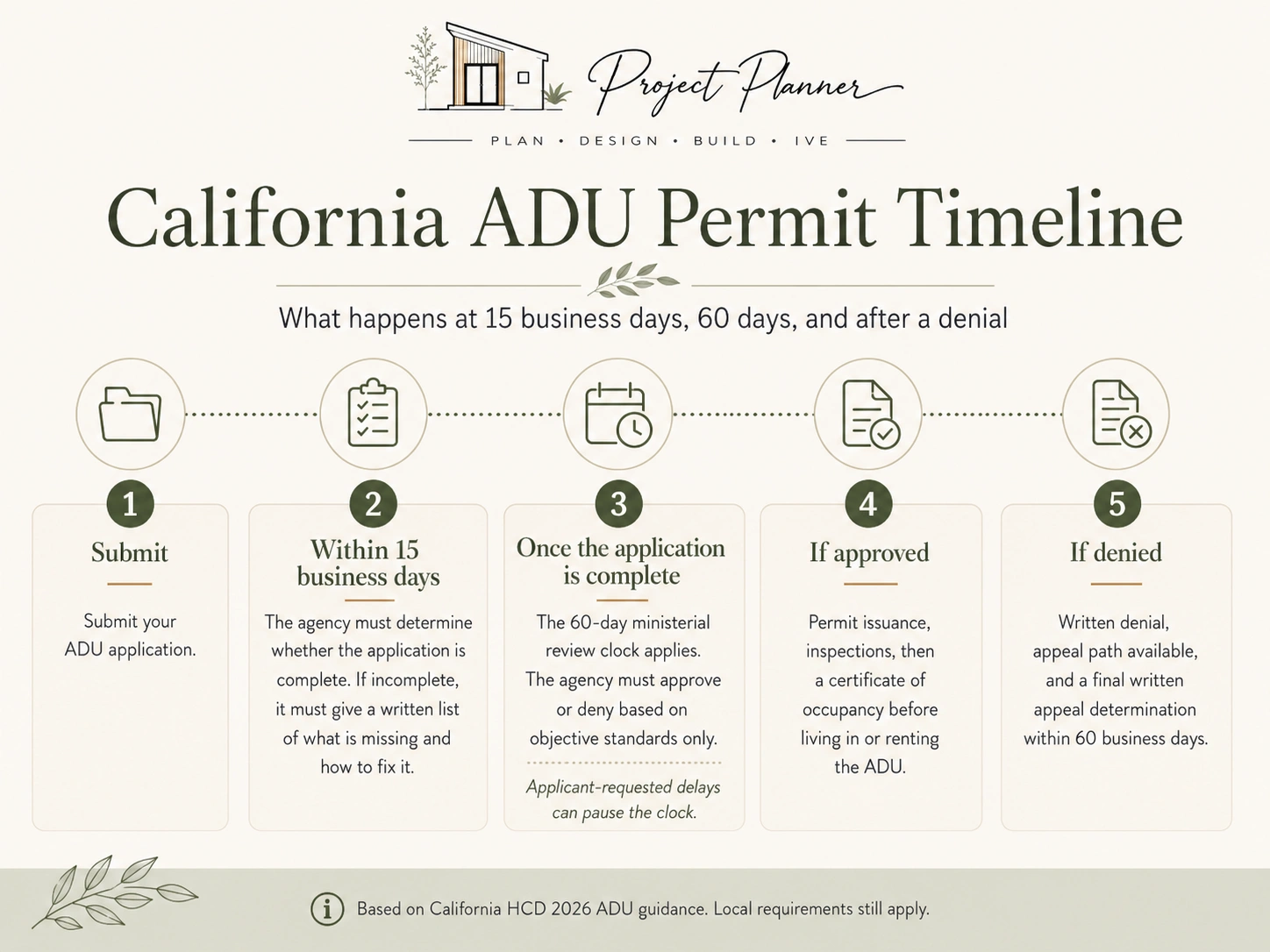
For most homeowners, an ADU permit in California has two key state-law checkpoints. The permitting agency must make a written completeness determination within 15 business days after receiving the application. For a completed application on a lot with an existing single-family or multifamily dwelling, the agency generally must approve or deny it within 60 days through a ministerial review process.
What this does not mean: California does not promise that your entire project will go from idea to an issued permit in 60 days. Property research, plan preparation, applicant-requested delays, corrections and site-specific requirements can add calendar time.
Start with the existing structure, slab, fire separation and utility questions that can change the permit package.
Garage conversion planning →See which California cities offer plan programs and what still has to be reviewed for your parcel.
Browse the plan finder →Check the 500-sq-ft limit, shared-space rules and 2026 owner-occupancy differences before designing.
Compare JADU vs ADU →Do not use the new-construction workflow blindly. Older units may qualify for California’s legalization protections.
Check the AB 2533 pathway →If you are researching an ADU permit in California, the most useful question is not simply, “How long does the city have?” It is:
“What do I need to do before and after submission so my application can actually move through the process?”
This guide walks through that process from the homeowner’s point of view.
In this guide
What changed in the California ADU permit process in 2026?
One of the most useful 2026 changes is procedural. Senate Bill 543 amended State ADU Law so that permitting agencies must make a written application-completeness determination within 15 business days after receiving an ADU application.
If the application is incomplete, the agency must identify the incomplete items and explain how the application can be made complete. Current law also provides a written appeal process when an application is determined to be incomplete or is denied.
California HCD’s March 2026 ADU Handbook explains that an ADU application is deemed complete if the permitting agency does not make the required timely written completeness determination.
Why this matters: homeowners now have a clearer early checkpoint. Instead of waiting indefinitely to learn whether the city considers the application complete, State ADU Law establishes a specific completeness-review timeline before the separate 60-day approve-or-deny period.
California ADU permit process at a glance
- Identify the correct permitting agency.
- Confirm the property and proposed ADU pathway.
- Check local standards and special site conditions.
- Decide whether to use custom or preapproved plans.
- Prepare the complete permit package.
- Submit the application and watch the 15-business-day completeness window.
- Move through the 60-day ministerial review period once complete.
- Resolve correction comments or use the appeal process if necessary.
- Pay applicable fees and obtain the issued permit.
- Build, complete inspections and obtain final approval before occupancy.
The sequence is straightforward on paper. The details are where homeowners lose time, so each step below focuses on what can actually delay a project.
Phase 1: Establish feasibility and prepare the design
| Responsibility | Typical owner | Evidence to keep |
|---|---|---|
| Jurisdiction and parcel constraints | Homeowner with designer or planning professional | Parcel information, written agency guidance and applicable standards |
| Plans, calculations and corrections | Designer, architect and/or engineer as required | Scope of services, submission set and correction log |
| Application status and fees | Named applicant or authorized representative | Submission receipt, completeness notice, invoices and permit record |
| Construction and inspections | Owner and licensed contractor under the contract | Issued plans, inspection records, approved changes and final approval |
Step 1: Identify the agency that will issue the ADU permit
For a conventional site-built ADU, start with the building or development-services department that has jurisdiction over the property. Depending on where the parcel is located, that may be a city or the county.
The California Contractors State License Board advises homeowners to check with the local building department because California generally requires permits before a building or structure is erected, constructed, enlarged, altered, repaired, improved, removed, converted or demolished.
This is especially important for garage conversions. Turning a garage into living space is not simply an interior decorating project; it changes the use of the space and must satisfy applicable residential building requirements.
Before paying for finished plans, confirm:
- which city or county has permitting authority;
- whether the property is incorporated or unincorporated;
- which department receives ADU applications;
- whether the jurisdiction uses an online permit portal;
- and whether separate utility, fire, health, septic or coastal reviews may apply.
Our ADU Rules by Location section can help you start with the correct jurisdictional layer.
Step 2: Confirm what type of ADU you are actually permitting
The permit package depends partly on what you are proposing. California recognizes several ADU configurations, including:
- detached new-construction ADUs;
- attached ADUs;
- ADUs created from existing space;
- garage and accessory-structure conversions;
- ADUs on multifamily properties;
- and Junior Accessory Dwelling Units (JADUs), which have their own statutory framework. See the 2026 JADU vs ADU requirements guide for the 500-sq-ft limit, kitchen, bathroom and owner-occupancy differences.
Do not assume that a design that works on another property automatically fits the legal pathway available on yours. The number of units, size, setbacks, height, existing structures and whether the primary dwelling already exists can affect the path.
Start with our property planning guide, then verify the current local ordinance and property-specific conditions.
Step 3: Check the property before finalizing the design
A permit application can be legally entitled to ministerial review and still run into practical property issues.
Check early for:
- property lines and easements;
- existing permitted and unpermitted structures;
- sewer or septic conditions;
- water service;
- electrical-service capacity;
- fire access and fire-hazard conditions;
- flood constraints;
- historic-resource considerations;
- Coastal Zone requirements;
- and the physical condition of any structure being converted.
For a garage conversion, verify that the garage itself is part of the lawful building record. If records are unclear, resolve that question before assuming the existing shell can simply be converted.
Step 4: Decide whether preapproved ADU plans actually help
Many California jurisdictions now offer or accept preapproved ADU designs. They can reduce repeated review of the standard building design, but preapproved does not mean permit-free.
Official local programs make this distinction clear. For example, California jurisdictions that publish preapproved-plan galleries still require site-specific work such as locating the ADU on the parcel, demonstrating setbacks and access, and addressing the foundation or property conditions.
A preapproved plan may be useful when:
- the design fits your site without major modification;
- the jurisdiction recognizes the plan;
- your property is reasonably straightforward;
- and the plan’s dimensions and construction system match your goals.
It may offer less benefit when the project involves a difficult slope, unusual access, existing-structure conversion, substantial customization, septic, complex utility work or another site-specific issue.
Phase 2: Submit, document and respond to review
Step 5: Build a complete ADU permit package
There is no single statewide document list that describes every drawing and calculation required for every California ADU. Local building departments administer the permit package, and requirements vary with project type and site conditions.
However, official local submittal guides show the types of documents homeowners should expect.
San Diego’s January 2026 ADU bulletin lists minimum plan materials such as a site plan and vicinity map, floor and roof plans, elevations and sections where applicable, structural plans and details, and structural or truss calculations where applicable.
San José’s ADU process also calls for a complete ADU submittal package and identifies items such as Title 24 residential energy calculations, CalGreen information, geotechnical information where applicable and other project-specific documentation.
Your package may therefore involve some combination of:
- permit application forms;
- site plan;
- existing and proposed floor plans;
- roof plan;
- building elevations;
- building sections;
- structural plans and calculations;
- foundation information;
- Title 24 / energy documentation;
- CalGreen documentation;
- truss calculations where applicable;
- geotechnical or soils information where applicable;
- septic documentation where applicable;
- and utility or fire documentation required by the local agency.
Do not copy this list as if every item is mandatory statewide. Use the current submittal checklist published by the actual permitting agency for your property.
Step 6: Submit the application and watch the 15-business-day completeness clock
Under current 2026 State ADU Law, the permitting agency must determine whether the ADU application is complete and provide written notice no later than 15 business days after receiving it.
If the agency says the application is incomplete, it must identify the incomplete items and describe how the application can be made complete.
This first deadline is different from the 60-day approval deadline.
| Checkpoint | What it means |
|---|---|
| 15 business days | Agency determines whether the application is complete and provides written notice. |
| 60 days | For a completed application on a lot with an existing single-family or multifamily dwelling, the agency generally must approve or deny the ADU application within this period. |
| 60 business days after written appeal | Current law establishes a deadline for the agency’s final written determination on an appeal of an incompleteness determination or denial. |
If the agency does not make the required timely completeness determination, HCD explains that the ADU application is deemed complete for purposes of this process.
Step 7: Understand what the 60-day ADU rule really means
California’s 60-day rule is one of the most misunderstood parts of ADU permitting.
For an ADU on a lot with an existing single-family or multifamily dwelling, the permitting agency generally must approve or deny the completed application within 60 days.
The review is ministerial. HCD describes ministerial review as applying objective standards without discretionary judgment or a public hearing. Staff may still review planning, building, fire, utility and other applicable objective requirements.
If the local agency has not approved or denied the completed application within the statutory period, State ADU Law provides that the application is deemed approved.
What the 60-day clock does not mean
- It does not start when you first decide to build an ADU.
- It does not replace the work required to prepare a complete application.
- It does not mean construction can begin before the necessary permit is issued.
- It does not mean every outside or property-specific requirement disappears.
- It does not include construction and inspection time.
If the ADU permit is submitted together with an application for a new primary dwelling, the agency may delay acting on the ADU until it acts on the permit for the new primary dwelling. If the applicant requests a delay, the 60-day period is tolled for the applicant-requested delay.
Step 8: Respond to correction comments strategically
Plan-check comments are not unusual. What matters is whether you receive a complete, actionable set of comments and respond to them systematically.
If an ADU application is denied, California HCD says the permitting agency must provide a full set of written comments identifying defective or deficient items and describing how the application may be remedied. HCD explains that the full set includes comments from all reviewers and permitting agencies involved.
After a denial, a subsequent application resets the 60-day period.
To reduce repeated correction cycles:
- group comments by discipline;
- create a written response matrix;
- identify exactly where each correction appears in the revised plans;
- avoid changing unrelated portions of the design unless necessary;
- and have the responsible designer or engineer address technical comments rather than guessing.
What if the city says the application is incomplete or denies it?
Current 2026 law requires a permitting agency to provide a written appeal process for an ADU application that is determined incomplete or is denied.
Government Code section 66317 requires a final written determination on the appeal no later than 60 business days after receipt of the written appeal.
Before escalating, first make sure the issue is actually a disagreement about the applicable standards rather than a missing drawing or unresolved technical item. HCD advises applicants to work through the permitting agency’s process first and provides an ADU portal for technical-assistance requests.
Phase 3: Obtain the permit, build and close out
Step 9: Pay applicable fees and obtain the issued permit
California does not have one statewide “ADU permit price.” Building-permit and plan-check charges vary by jurisdiction and project, while State ADU Law separately limits certain impact fees.
Do not confuse:
- permit and plan-check fees;
- development impact fees;
- school impact fees;
- utility connection or capacity charges;
- and the physical cost of utility construction.
For a deeper breakdown of these distinctions, see our California garage conversion ADU cost guide and the broader ADU Costs hub.
Step 10: Build only from the approved plans
Once the permit is issued, construction should follow the approved permit set and applicable inspection sequence.
Common inspection stages can include work such as:
- foundation or footing;
- underground plumbing or utilities;
- framing;
- rough electrical, plumbing and mechanical;
- insulation;
- drywall or other concealed-work checkpoints;
- and final inspection.
The exact sequence depends on the project and local building department.
Ready to build? Follow our ADU construction process guide for stage-by-stage homeowner actions, inspection checkpoints and a construction meeting planner.
If a field condition forces a meaningful change from the approved drawings, do not assume the contractor can simply make the change. Ask whether a revision or deferred submittal is required before the altered work proceeds.
Step 11: Obtain final approval before anyone moves in
Permit issuance is not the end of the process.
California HCD’s March 2026 handbook states that property owners must obtain a Certificate of Occupancy from the local agency before residential occupancy of an ADU or JADU.
Before treating the ADU as complete, confirm:
- all required inspections are passed;
- open correction items are resolved;
- required final documents are submitted;
- the permit is finaled;
- and the required Certificate of Occupancy has been issued.
Special situations: Coastal Zone and existing unpermitted units
What if the property is in California’s Coastal Zone?
State ADU Law does not erase the Coastal Act. A coastal development permit may still be required depending on the location and applicable certified Local Coastal Program.
California’s 2026 ADU framework now includes specific timing rules for ADU-related coastal development permit applications. But homeowners should not treat the ordinary building-permit timeline as proof that no coastal review applies.
If your property is near the coast, confirm the coastal layer before paying for a design that depends on assumptions about setbacks, access or permit timing.
What if the ADU already exists but was never permitted?
Do not apply the new-construction permit process blindly to an existing unpermitted unit.
California law provides a specific legalization framework for certain unpermitted ADUs and JADUs constructed before January 1, 2020. HCD’s 2026 handbook explains that local agencies generally cannot deny qualifying legalization permits merely because of building-code or ADU-law noncompliance, although health-and-safety and substandard-building findings can still require correction or support denial.
This is a separate issue that deserves its own guide. If you have an existing unpermitted unit, gather evidence of when it was built and contact the local building department about its current legalization process before making alterations.
California ADU permit-readiness checklist
Before submitting, you should be able to answer these questions:
| Question | Ready? |
|---|---|
| I know which city or county has jurisdiction. | ☐ |
| I know the ADU type and legal pathway I am using. | ☐ |
| I checked local ADU standards and current submittal instructions. | ☐ |
| I checked property records and existing structures. | ☐ |
| I identified easements and property lines. | ☐ |
| I checked sewer/septic and water conditions. | ☐ |
| I checked electrical-service capacity early. | ☐ |
| I checked fire, flood, historic and Coastal Zone issues where applicable. | ☐ |
| My site plan is based on accurate property information. | ☐ |
| My plan package follows the current local checklist. | ☐ |
| Required structural and energy documents are included. | ☐ |
| I know who will respond to plan-check comments. | ☐ |
| I have verified current local permit and related fees. | ☐ |
| I understand that permit approval and construction completion are separate timelines. | ☐ |
Five permit mistakes that cost homeowners time
1. Designing before checking the parcel
A beautiful plan is not useful if an easement, septic constraint, utility issue or site condition forces the design to change.
2. Treating “preapproved” as “already permitted”
Preapproved designs still need to be applied to a real site and go through the jurisdiction’s site-specific permit process.
3. Starting the 60-day clock in your head too early
The statutory approve-or-deny period is tied to a completed application, not the date you first contact the city or hire a designer.
4. Ignoring utilities until plan check
Electrical capacity, sewer, septic, water and trenching can affect both design and construction. Investigate them before the project becomes difficult to change.
5. Responding to corrections one comment at a time
A coordinated response package is usually more efficient than repeatedly resubmitting partial fixes.
Frequently asked questions about California ADU permits
Do you need a permit for an ADU in California?
Generally, yes. New ADU construction and conversion of existing space into a legal dwelling require the applicable building permit and code review. Check the local building department for the exact permit type and submittal requirements.
How long does it take to get an ADU permit in California?
There is no single end-to-end timeline. Under current State ADU Law, the agency has 15 business days to make the application-completeness determination, and a completed ADU application on a lot with an existing single-family or multifamily dwelling is generally subject to a 60-day approve-or-deny period. Design, pre-submittal investigation, corrections, applicant delays and special property requirements can extend the total calendar time from idea to issued permit.
What happens if the city does not act within 60 days?
Government Code section 66317 provides that if the local agency has not approved or denied a completed qualifying ADU application within the statutory 60-day period, the application is deemed approved. Because permit issuance and construction still involve administrative and building-code steps, document the timeline and work with the permitting agency rather than assuming you can begin construction without the issued permit documents.
How much does an ADU permit cost in California?
There is no statewide permit price. Local building and plan-check fees vary, and other charges depend on jurisdiction, project size, utilities and project type. Get a current written estimate from the actual permitting agency and relevant service providers.
Can I build an ADU without a permit?
Do not build a new ADU without the required permit. Unpermitted work can create safety, financing, insurance, appraisal and future-sale problems. California now has a legalization path for certain older unpermitted ADUs, but that is not a reason to construct new unpermitted work.
How do I check whether an existing ADU was permitted?
Start with the city or county’s building-record system and look for the permit history, approved plans where available, inspection status and final approval. If records are incomplete or unclear, ask the building department what documentation establishes legal status for that property.
Before you submit an ADU permit application
Confirm the state rules, then verify the city/county and property-specific layer. The fastest permit application is usually the one that reaches plan check with the major site questions already answered.
Bottom line
California has made ADU permitting much more structured than it once was. In 2026, the process includes an early 15-business-day completeness checkpoint, ministerial review, a 60-day approve-or-deny timeline for qualifying completed applications, written correction requirements and an appeal process.
But state deadlines do not replace good project preparation.
The homeowner who understands the parcel, chooses the right ADU pathway, submits a complete local plan package and resolves utilities and site constraints early is in a much stronger position than someone who focuses only on the 60-day headline.
Your goal is not simply to submit quickly. It is to submit a package that can be reviewed cleanly.
Official sources used for this guide
- California Department of Housing and Community Development — ADU Handbook (updated March 2026)
- California HCD — Accessory Dwelling Unit Handbook, March 2026 (PDF)
- California HCD — Accessory Dwelling Units
- California Contractors State License Board — Building Permit Requirements
- City of San Diego — ADU/JADU Information Bulletin 400, January 2026
- City of San José — ADU Project Process
- Los Angeles Department of Building and Safety — Plan Check & Permit
Editorial note: ADU laws and local permit procedures change. This article is educational planning guidance, not legal, architectural, engineering or construction advice. Verify current requirements with the permitting agency and qualified professionals before relying on a timeline or submittal list. See our Editorial & Source Policy.
7 thoughts on “California ADU Permit Process (2026): Steps, Timelines & Checklist”